

By admin / 31 July 2026

Australia remains a popular destination for skilled South Africans seeking permanent residency (PR) and stable employment. English proficiency, transferable qualifications, and a strong history of successful migration give many South Africans an advantage. As of mid-2024, around 224,160 South African-born people lived in Australia. Permanent migration from South Africa occurs mainly through skilled and employer-sponsored streams.
Australia’s permanent Migration Program prioritizes skilled workers who fill labor shortages. The 2026–27 program continues this focus, with a large share of places allocated to the skilled stream. Permanent residency allows unrestricted work, access to Medicare, pathways to citizenship, and the ability to sponsor eligible family members.
Important note: Immigration rules, occupation lists, points thresholds, and state nomination criteria change. Always verify details on the official Department of Home Affairs website (immi.homeaffairs.gov.au) and consider advice from a registered migration agent (MARA-registered).
Main Pathways to Permanent Jobs and Residency
South Africans typically pursue these routes:
- Skilled Independent Visa (subclass 189) – Points-tested stream. A permanent visa for skilled workers whose occupation is on the relevant skilled occupation list. No job offer, employer sponsorship, or state nomination is required. Holders can live and work anywhere in Australia.
- Skilled Nominated Visa (subclass 190): A permanent visa requiring nomination by an Australian state or territory government. Nomination adds points and often improves invitation chances. Holders generally commit to living and working in the nominating state for a period.
- Skilled Work Regional (Provisional) Visa (subclass 491): A five-year provisional visa for skilled workers nominated by a state/territory or sponsored by an eligible family member, requiring residence and work in a designated regional area. It provides a pathway to permanent residency via the Permanent Residence (Skilled Regional) visa (subclass 191) after meeting residence and income requirements (typically three years).
- Employer-Sponsored Pathways
- Skills in Demand visa (subclass 482) (temporary, previously Temporary Skill Shortage): Allows work for a sponsoring employer. Many holders later transition to permanent residency.
- Employer Nomination Scheme (subclass 186): Permanent visa for skilled workers nominated by an approved Australian employer (Direct Entry or Temporary Residence Transition streams). Regional employer options (such as subclass 494) also exist and can lead to PR.
Other options include the Global Talent visa (for exceptional achievers) and partner or family visas, but skilled and employer routes are the primary paths for permanent jobs.
South African permanent migration data shows significant numbers in Employer Sponsored, Skilled Independent, and State/Territory Nominated categories in recent years.
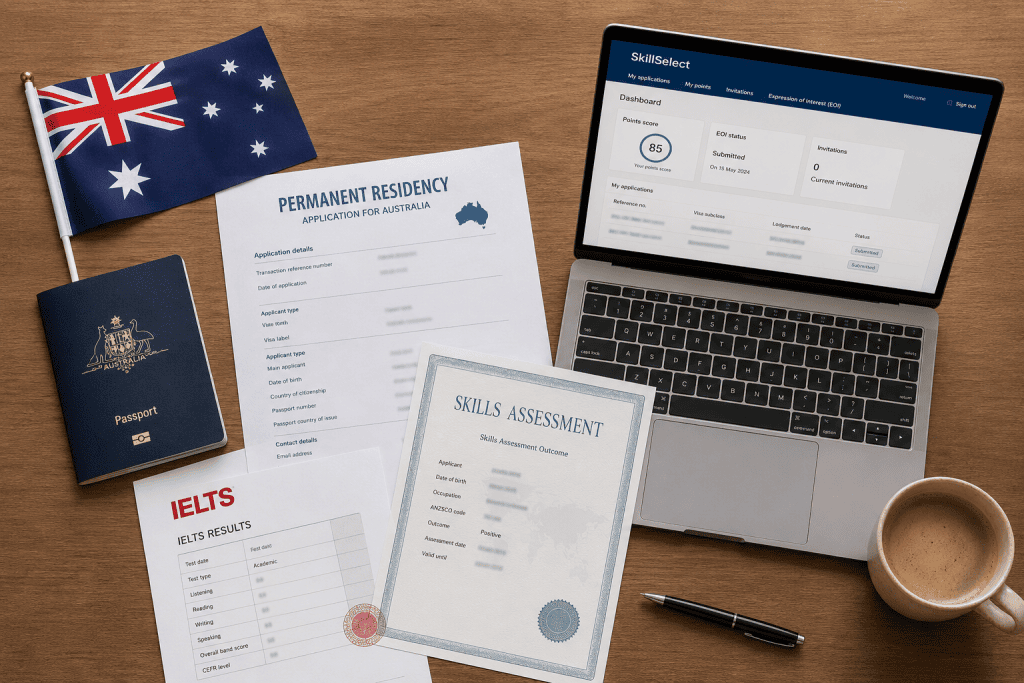
Step-by-Step Process for Skilled Migration (189/190/491)
The general process for points-tested skilled visas follows these stages:
- Confirm your occupation is eligible. Check the skilled occupation list on the Home Affairs website. Occupations are linked to lists such as the Medium and Long-term Strategic Skills List (MLTSSL) and others relevant to specific visas. Each occupation has an ANZSCO code and a designated assessing authority.
- Obtain a suitable skills assessment. Apply to the relevant assessing authority (e.g., Engineers Australia, Australian Computer Society, VETASSESS, or medical boards) for a positive skills assessment confirming your qualifications and experience meet Australian standards. This is mandatory and can take months.
- Meet English language requirements: Demonstrate at least Competent English (e.g., IELTS 6.0 in each band or equivalent)—higher scores (Proficient or Superior) award more points. South Africans often perform well here due to English being widely used.
- Calculate your points score. You need a minimum of 65 points on the points test at the time of invitation, though competitive scores are often higher. Points are awarded for:
- Age (maximum 30 points for 25–32 years; applicants must generally be under 45)
- English proficiency (up to 20 points)
- Skilled employment experience (Australian and/or overseas)
- Educational qualifications
- Australian study, specialist qualifications, partner skills, and other factors. State nomination (190) adds 5 points; regional nomination or family sponsorship (491) adds 15 points.
- Submit an Expression of Interest (EOI) in SkillSelect. Create an EOI online detailing your claims. No documents are uploaded at this stage. Keep it accurate and up to date. Invitations are issued periodically based on ranking and government priorities.
- Receive an invitation to apply. If invited (for 189) or nominated and invited (for 190/491), you have a limited time (usually 60 days) to lodge a full visa application.
- Lodge the visa application: Provide evidence supporting all claims, pay the visa application charge (from approximately AUD 6,135–6,140 for the main applicant as of recent figures; use the official Visa Pricing Estimator), and complete health examinations and character checks (police clearances). Processing times vary and are prioritized according to ministerial directions (e.g., certain occupations or onshore applicants may be faster).
- Visa grant and arrival: Once granted, you become a permanent resident (or provisional for 491) and can work unrestricted (subject to any regional conditions).
For employer-sponsored routes, the process centers on finding a willing, approved Australian employer who nominates you, followed by the relevant visa application. Employers must generally demonstrate they cannot fill the role locally.


Opportunities Available for South Africans
Australia faces ongoing skill shortages in several sectors, creating strong demand for qualified migrants. High-demand areas frequently include:
- Healthcare: Registered nurses, medical practitioners, aged care workers, and allied health professionals.
- Information Technology and Cybersecurity: Software engineers, developers, ICT security specialists, and systems administrators.
- Engineering: Civil, mechanical, electrical, and related engineers.
- Trades and Construction: Electricians, plumbers, diesel mechanics, carpenters, and other skilled trades.
- Education: Teachers (especially in shortage subjects or regional areas).
Regional Australia often has broader occupation lists and faster pathways via state nomination or the 491 visa, with incentives for living outside major cities such as Sydney, Melbourne, and Brisbane. States and territories publish their own nomination occupation lists and criteria (e.g., South Australia, Victoria, and others actively recruit skilled migrants).
South Africans with professional or trade qualifications in these fields, combined with solid English and relevant experience, are well-positioned. Many succeed without a pre-arranged job offer via the independent skilled routes, then secure employment after arrival. Employer sponsorship remains viable for those who network or are recruited directly.
Practical Tips and Considerations
- Start early: Skills assessments, English tests, and document gathering take time.
- Research state nomination requirements carefully—each state has different priorities, points thresholds, and commitment expectations.
- Budget for costs: Skills assessment fees, English tests, medicals, police checks, visa charges, and possible agent fees.
- Character and health: All applicants (and family members) must meet health and character requirements.
- Job search support: Once on a visa, use platforms such as Seek, LinkedIn, and industry networks. Recognition of South African qualifications is common in many fields after skills assessment.
- Citizenship pathway: Permanent residents can usually apply for citizenship after meeting residence requirements (generally four years, including one as a permanent resident).
South Africans have a long track record of successful settlement in Australia. With careful preparation, the right occupation, competitive points, and adherence to official processes, permanent skilled employment and residency are achievable goals. Always cross-check the latest information directly with the Department of Home Affairs and consider professional advice tailored to your circumstances.